
One high voltage transmission line proposed by the Lower Colorado River Authority (LCRA) and the private firm Oncor continues to push many Burnet County residents into a flood of fierce debate.
Many residents believe the line poses significant health and safety risks.
More than 100 Bur- net County residents crowded into a public workshop Jan. 16 to discuss the transmission line. Burnet County Judge Bryan Wilson hosted the discussion, which extended two hours in Burnet at the County AgriLife Extension, 607 N. Vandeveer.
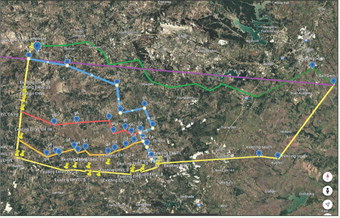
The 765-kilovolt line proposed by LCRA would extend from the Bell County East to the Big Hill electrical station across a vast section of rural areas through several Texas counties, including Burnet County.
Currently, the proposal is on hold, pending review by the Public Utility Commission of Texas (PUCT).
Wilson condemned the proposal at outset of the workshop.
“We feel like it threatens our way of life,” the judge said.
No attendees openly disagreed.
Burnet County Historical Commission preservationist Nicole Westhoff expressed concern related to how many burial grounds, homes or other historical properties in the county be adversely affected if the transmission line is installed.
Ray Feeley pointed out the transmission line could affect people who use pacemakers. Other residents in the crowd sounded opposition more bluntly.
“I don’t want any power lines in this county,” John Nelson said, drawing applause.
Also, Charlie Parker spoke.
“I feel we are at war in the county with corporatism that puts people at risk,” Parker said.
Citing her long experience as an engineer, Cynthia Klinsman pointed out LCRA and Oncor could be building a transmission line that could turn into an archaic contraption within a short number of years.
Wilson reminded attendees; the Burnet County Commissioners Court passed a formal resolution against the line last October 28.
However, the judge added, county officials possess no substantive authority to block the project.
“The county cannot regulate transmission lines the way it regulates septic systems,” Wilson said.
In fact, Texas law stipulates PUCT is the primary authority to decide whether to approve or deny the installation of the line, Wilson reminded the crowd.
“It is very discouraging – isn’t it?” Wilson asked.
However, local Attorney Margaret Pemberton encouraged attendees to contact PUCT officials through e-mails to www.puc.texas.gov.
“It is one of the few tools available to individual landowners,” Pemberton said.
The attorney added, numerous associations could be drawn into the fight against the line, including the Texas Public Policy Foundation, the Texas Cattlemen’s Association, and the Central Texas Groundwater District and state lawmakers.
“We want everybody to be aware of the situation,” Pemberton said. “We do not know yet who all could really be affected.”
Dan Byfield reminded attendees one group of private citizens called the “391 Commission” helped derail the $80-billion proposal for the “Trans-Texas Corridor” highway system almost 20 years ago.
“We can do the same there,” Byfield said. “Get it (the LCRA proposal) into the next legislative session and kill it.”
The remarks by Byfield drew loud applause.